What is commercial heating?
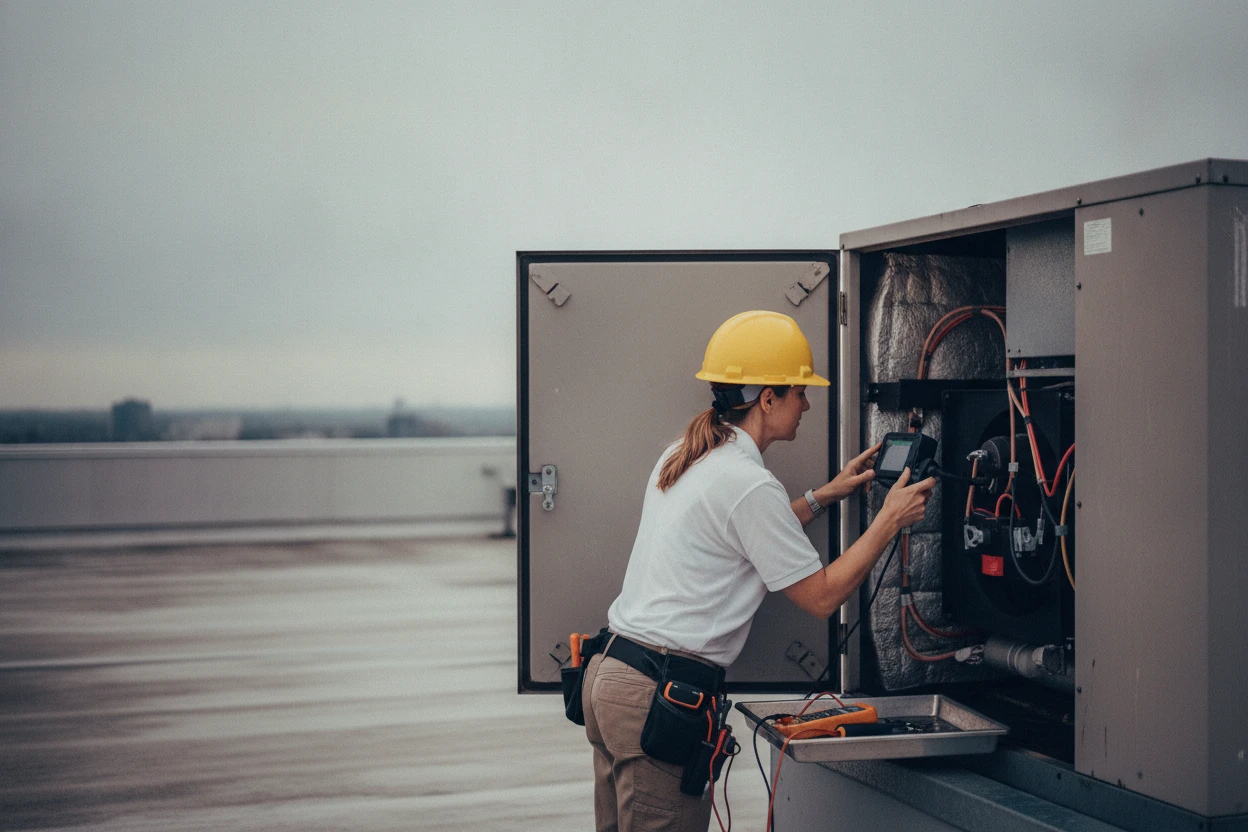
Commercial heating is the equipment that heats business and industrial buildings, rooftop gas packaged units, commercial furnaces, hot-water or steam boilers, and heat pumps, sized to a building’s load and built for long run hours, zoning, and code. It’s engineered around uptime rather than being a scaled-up version of a home system.
How does commercial heating work?
Most commercial systems either burn gas or move heat with a heat pump, then distribute it as warm air through ductwork or as hot water or steam through piping. Rooftop packaged units combine heating and cooling in one cabinet, while boilers circulate heat to radiators, baseboard, or air handlers. Controls and thermostats stage the equipment to hold temperature across the building.
What are the types of heat used in commercial buildings?
The common types are forced-air gas (rooftop units and furnaces), hydronic or steam heat from boilers, heat pumps including VRF, and radiant. Each uses a different fuel and distribution method, and the best fit depends on building size, use, and the existing system. We help you match the type to your building.
What are the different heating options for commercial buildings?
Options include rooftop gas packaged units, commercial furnaces, hot-water and steam boilers, air-source and geothermal heat pumps, VRF systems for multi-zone control, and radiant heat. Most small-to-mid buildings do well with rooftop gas or a heat pump, while larger and older buildings often use boilers. We size and recommend based on your load and layout.
Which type of heating system is most common in industrial and commercial environments?
Rooftop packaged units are the most common for small-to-mid commercial buildings because they’re cost-effective, space-saving, and easy to service. Larger and older or industrial facilities frequently use boilers, and multi-tenant or variable-load buildings often use VRF. The right choice comes down to a load calculation for your building.
What are the four types of heating systems?
Broadly, the four are furnaces (forced warm air), boilers (hydronic or steam), heat pumps (which move heat and also cool), and radiant systems. They differ in fuel, distribution, efficiency, and maintenance. Commercial buildings often combine these, such as a heat pump with gas backup.
Why is my commercial heat not working?
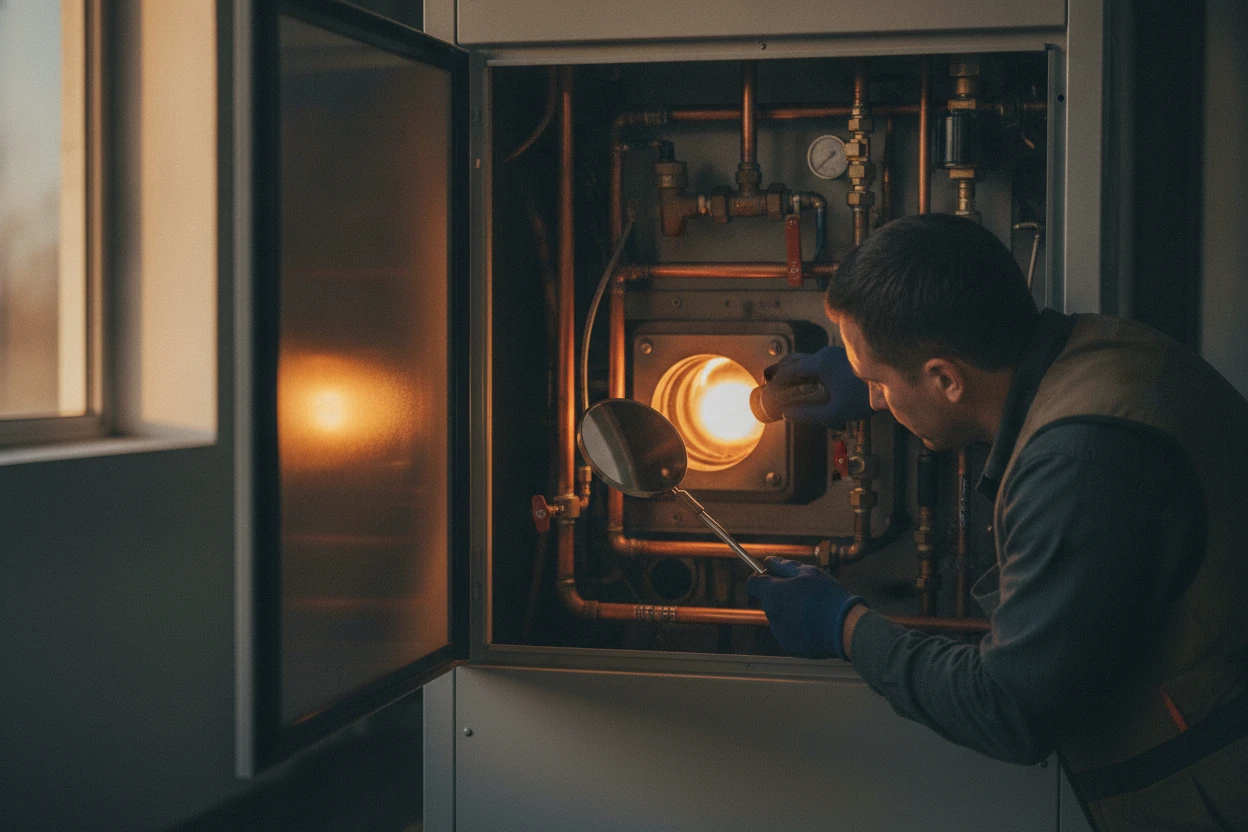
Common causes are ignition or flame-sensor faults, a gas valve or pressure problem, a safety lockout, a clogged filter tripping the high-limit, a failed inducer or blower motor, or a thermostat and control fault. Because a gas system is a combustion appliance, some faults are safety-related. We diagnose the actual cause rather than just resetting it, and answer no-heat calls right away.
How do I reset a commercial HVAC heating system?
Many units restart from the thermostat or by cycling power at the unit’s disconnect, but a lockout is a safety response, not something to keep overriding. Try one reset and replace a dirty filter; if it locks out again, leave it off and call. Never bypass a safety control on a gas system to force it to fire.
Is commercial HVAC the same as residential?
No. Commercial equipment is larger, often on three-phase power, sized to a building’s load, and engineered around uptime, zoning, economizers, and code. It runs longer hours and needs technicians and parts geared for it, so it isn’t just a bigger home system.
Is there a tax credit for commercial heating systems in 2026?
The residential 25C credit expired at the end of 2025, but commercial buildings may still qualify for the 179D energy-efficient commercial buildings deduction on qualifying efficiency upgrades, and utility or state rebates sometimes apply. Eligibility and amounts depend on your project and tax situation, so confirm current rules with your tax professional. We provide the equipment efficiency documentation you’ll need.
How many BTUs do I need to heat my commercial space?
A rough starting point for our mild climate is about 30 to 45 BTU per hour per square foot, adjusted up for high ceilings, poor insulation, or heavy ventilation. So a 5,000 square foot space might need roughly 150,000 to 225,000 BTU, but the real figure depends on the building. Our estimator above gives a ballpark, and a load calculation sets the exact size.
What is the most common cause of commercial heat not working?
Ignition problems, a dirty flame sensor or a failed igniter, and safety lockouts are the most common, followed by thermostat, gas-supply, and motor faults. Most start as weak or intermittent heat before a full failure, which is the moment to call. Regular maintenance prevents the majority of these.
Should I choose residential or commercial HVAC?
It follows the building, not preference. A business, multi-tenant, or industrial space needs commercial equipment sized and rated for the load and its code requirements, while a home uses residential gear. If you’re unsure, we’ll assess the building and confirm which class of equipment fits.
 Review on Google · April 2026